
The Tale of Two Comeback Cities
St. Louis and Detroit share a lot of DNA. Both are legacy industrial powerhouses built on brick, grit, and river trade. Both weathered decades of population loss and disinvestment. Both are now writing turnaround stories — Detroit with a headline-grabbing population rebound, St. Louis with a quieter but steady metro-level stability and a job market that just ranked third nationally for growth Greater STL Inc., 2025.
But the day-to-day experience of living in each city diverges in ways that matter deeply. Detroit is bigger, bolder, and undeniably on a hot streak. St. Louis is more intimate, more architecturally intact, and offers a cultural value proposition — free zoo, free art museum, free science center — that virtually no other American city can match Forest Park Forever, 2025.
This comparison is built for two audiences: young people starting careers and families putting down roots. Both cities have something real to offer. Neither is perfect. The right choice depends on what you value most.
The Numbers at a Glance
| Metric | St. Louis (City) | Detroit (City) |
|---|---|---|
| Population (city) | ~279,695 (2024) BizJournals | ~649,095 (2025) CBS Detroit |
| Metro population | ~2.81 million EWGateway, 2024 | ~4.3 million Detroit MI.gov, 2025 |
| Median home price | ~$260,000 Redfin (mid-2026) | ~$103,000 Redfin (mid-2026) |
| Median rent | ~$1,250–$1,448 Steadily / RentCafe, 2025 | ~$1,100 Realtor.com, 2025 |
| Median household income | ~$53,374 Census Reporter, 2024 | ~$39,209 Census Reporter, 2024 |
| Homicides | 141 (2025, 12-year low) SLMPD | 165 (2025, lowest since 1965) Detroit MI.gov |
Where St. Louis Wins
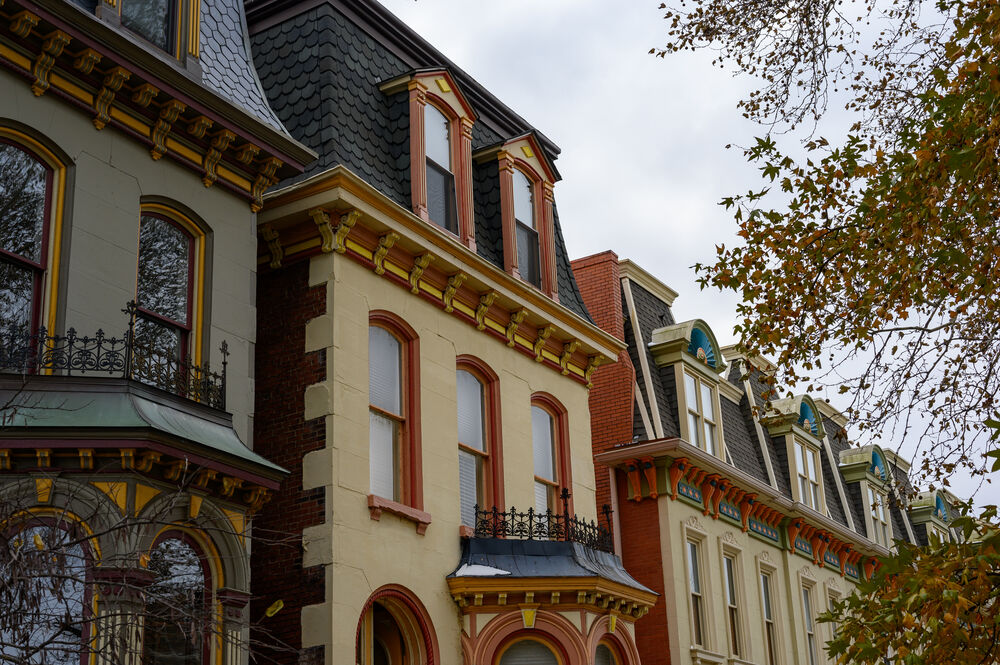
Historic housing stock that stops people in their tracks. St. Louis's brick Victorians, Gilded Age mansions, and Arts and Crafts four-squares survived the mid-century demolition wave far more intact than Detroit's. Walk through Lafayette Square, Compton Heights, or the Central West End and you'll see block after block of meticulously preserved 19th- and early-20th-century homes — at prices that feel like a typo to anyone moving from the coasts. Detroit has beautiful historic pockets too (Brush Park, Indian Village), but St. Louis's architectural fabric is simply more continuous. As one Reddit observer put it: "For having similar levels of population loss, St. Louis has much more intact neighborhoods" Reddit, 2023.
Free cultural institutions that are genuinely world-class. The Saint Louis Zoo, Saint Louis Art Museum, and Saint Louis Science Center — all in Forest Park, all free admission, every day. Forest Park itself is 1,326 acres, larger than Central Park Forest Park Forever, 2025. Detroit's Belle Isle (982 acres) is lovely and offers a free aquarium and a newly renovated conservatory Belle Isle Conservancy, 2024, but the Detroit Institute of Arts charges admission for non-residents. St. Louis's free cultural access is virtually unmatched in the U.S. St. Louis MO.gov, 2025.
Higher city incomes and a lower tax bite. St. Louis city households earn about 36% more than Detroit city households — $53,374 vs. $39,209 Census Reporter STL / Census Reporter Detroit, 2024. And as a city resident, your combined state + local income tax rate is 5.7% in St. Louis (4.7% Missouri top rate + 1% earnings tax) vs. 6.65% in Detroit (4.25% Michigan flat + 2.4% city tax) TaxAct Missouri / TaxAct Michigan / STL MO.gov, 2025. That gap narrows if you live in the suburbs and work in the city, but for city residents, St. Louis leaves more in your pocket.
A light-rail system that actually goes places. MetroLink covers 46 miles and carried 7.7 million riders in 2025, connecting the airport, Forest Park, Clayton, and the Illinois suburbs Wikipedia, 2025. Detroit's QLine streetcar runs 3.3 miles along Woodward Avenue — useful for a narrow corridor, but not a regional transit solution QLine, 2025. Both cities remain car-dependent, but St. Louis gives you at least some car-free options.
Milder winters, more sun. St. Louis averages 202 sunny days per year to Detroit's 183, with winter lows around 25°F vs. Detroit's 19°F BestPlaces, 2025. Detroit summers are less humid, which is a real tradeoff, but if winter is your least favorite season, St. Louis has the edge.
Where Detroit Wins
Undeniable momentum. Detroit posted its third consecutive year of population growth in 2025 — the first sustained growth since 1957 CBS News Detroit, 2025. Homicides dropped to 165, the lowest since 1965 Detroit MI.gov, 2025. Billions are flowing into EV plant investments from GM, Ford, and Stellantis Detroit Playbook, 2025. St. Louis's job growth ranking is impressive, but Detroit's narrative has flipped from "struggling" to "rising" in a way that's attracting national attention and new residents.
A major international airport. Detroit Metro (DTW) offers nonstop service to ~136 destinations, including Shanghai, Tokyo, and multiple European cities FlightConnections DTW, 2025. St. Louis Lambert offers ~64 nonstops FlightConnections STL, 2025. A new British Airways flight to London begins April 2026 FlySTL, 2025, but its longevity isn't proven — previous transatlantic service from St. Louis has come and gone. If you travel internationally for work or family, Detroit wins by a wide margin.
All four major sports, all downtown. The Lions, Tigers, Pistons, and Red Wings all play in or near downtown Detroit — a rare setup that creates genuine energy on game days Wikipedia, 2025. St. Louis has the Cardinals, Blues, and the wildly popular CITY SC (MLS), plus the UFL Battlehawks — but no NBA or NFL team.
A globally recognized music legacy. Motown. Techno. The Movement Festival. Jazz at Baker's Keyboard Lounge. Detroit's music DNA is woven into global culture in a way few cities can claim. St. Louis has a strong blues and indie scene, but Detroit wins on music heritage and national touring acts decisively.
A larger, more diverse metro. Detroit's metro area is roughly 4.3 million people to St. Louis's 2.81 million EWGateway, 2024. That means more restaurants, more cultural communities, more of everything that comes with scale. As one Reddit user put it: "Detroit is noticeably more diverse than St. Louis" and "being larger, Detroit will probably give you more options in the art/music scene" Reddit, 2019.
Access to Michigan's outdoors. The Great Lakes, northern forests, and thousands of inland lakes are within a few hours' drive. St. Louis has the Ozarks and Missouri wine country, but Michigan's water-and-woods recreation is hard to beat.
The Housing Story: Two Kinds of Opportunity
Both cities offer something vanishingly rare in 2026 America: beautiful, historic homes at prices that don't require a trust fund. But the experience is different.
In St. Louis, you're buying into neighborhoods that feel like outdoor architectural museums. The Central West End's mansions, Lafayette Square's painted ladies, Tower Grove's brick Victorians — these are homes with stained glass, carved mantels, and third-floor ballrooms, often priced between $300K and $700K. For young professionals, neighborhoods like Soulard, The Grove, and Tower Grove South offer historic flats and starter homes with character that new construction can't replicate Extra Space, 2025. For families, Ladue, Clayton, Kirkwood, and Webster Groves pair top-ranked schools with century-old homes on tree-lined streets Gladys Manion, 2025.
In Detroit, the median sale price of ~$103,000 reflects a market with many distressed and vacant properties Redfin, 2026. A renovated home in Midtown, Corktown, or Brush Park costs far more — but still dramatically less than comparable historic homes in other cities. The opportunity is real, but it requires block-by-block diligence. Detroit's suburban family corridors — Birmingham, Northville, Grosse Pointe — offer elite schools and beautiful homes at prices that are high for Michigan but low by national standards That Detroit Life, 2026.
Job Markets: Healthcare vs. Automotive
St. Louis's economy is anchored by healthcare (BJC HealthCare, ~30,000 employees), higher education (Washington University), aerospace (Boeing, ~16,000 employees), and financial services (Wells Fargo Advisors) ClearPointHCO / WashU Careers, 2025. These sectors are relatively recession-resistant — people need healthcare and education in good times and bad.
Detroit's economy is anchored by automotive (GM, Ford, Stellantis) and a growing fintech sector (Rocket Companies), plus a major healthcare presence (Henry Ford Health) and the University of Michigan's gravitational pull Detroit Chamber, 2025. The auto industry's EV transformation is driving billions in new investment, but the sector remains cyclical.
St. Louis's job market just posted its strongest growth rate showing in years, ranking third nationally Greater STL Inc., 2025. Detroit's job market is larger overall, with the auto industry's resurgence creating real momentum.
Schools: Suburban Excellence in Both Cities
Neither city's urban school district is a selling point. St. Louis Public Schools and Detroit Public Schools Community District both face significant challenges. But both metros offer elite suburban districts that rank among the best in their states.
In St. Louis, Ladue, Clayton, and Kirkwood consistently top Missouri rankings US News, 2025. Top private options include MICDS, John Burroughs, and St. Louis University High Independent Schools of STL, 2025.
In Detroit, Birmingham, Northville, and Grosse Pointe lead Michigan rankings, with top charter schools like Detroit Edison and University Prep offering strong alternatives within the city Charter Schools.org, 2024. Elite private schools include Cranbrook and Detroit Country Day CBS Detroit, 2025.
Pick St. Louis if…
- You want a historic home with architectural soul — stained glass, exposed brick, carved woodwork — at a price that feels like a secret
- Free world-class cultural institutions (zoo, art museum, science center) matter to your family's weekly quality of life
- You work in healthcare, aerospace/defense, or financial services
- You want milder winters, more sunny days, and a lower combined city + state income tax rate as a city resident
- You value a light-rail system that connects the airport and key neighborhoods
- You prefer dense, walkable historic neighborhoods that feel architecturally intact
- You're a baseball or soccer fanatic who wants game-day culture woven into city life
Pick Detroit if…
- You want to be part of a city with undeniable positive momentum — population growing, crime falling, investment rising
- You need a major international airport with direct flights to Asia and Europe
- You work in automotive, EV, fintech, or want a larger job market overall
- You want all four major pro sports clustered in and around one downtown, plus a globally recognized music legacy
- You want access to Michigan's lakes, forests, and outdoor recreation
- You're willing to bet on a city's turnaround story for long-term upside in housing and community
- You value a larger, more diverse metro area with the cultural options that come with scale
Both cities reward people who look past headlines and do the neighborhood-level homework. Both offer a cost of living that makes a beautiful, culturally rich life achievable on a middle-class income. The question isn't which city is better — it's which city fits the life you're trying to build.